Tobacco systems
Chongololos: connected barns that cure as one system.
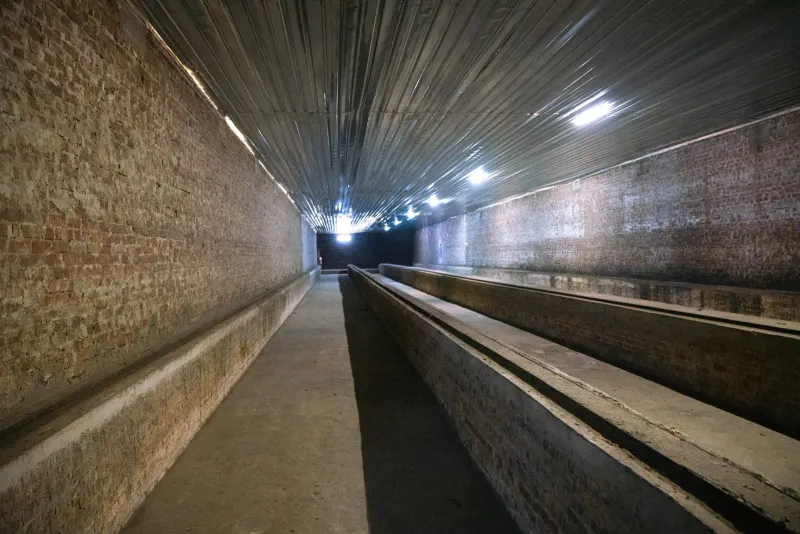
A chongi links your curing barns so heat and air run through them in sequence instead of each barn working on its own. It is worth considering when you want better control and more efficient heat use from barns you already have, without moving to a trolley tunnel.
Tobacco curing
A chongi is a curing system, not just a building.
Around here a chongi means a set of connected barns where the heat and air run through the chambers in sequence, instead of each barn working on its own. Unlike a tunnel, a chongi has no trolleys. The clips are loaded in and hung by hand, high up and down low, so it takes more labour to fill and empty. What you get back is more hands-on control over the cure.
- 01
No trolleys, loaded by hand
- 02
More labour, but more control over the cure
- 03
Good for upgrading old barns
Configurations
Super Eco Chongi options
8-barn conversion
01Convert 8 × 16 × 20 ft barns · ~75,000 leaves/day · ~1,600 kg/barn on strips
Brings older billy-barn capacity into a connected, more efficient curing system.
RS-28
0224 × 24 m · ~120,000 leaves/barn · ~2,600 kg/barn on strips
A connected chongi layout for farms stepping up curing capacity.
RS-50
0324 × 40 m · ~210,000 leaves/barn · ~4,600 kg/barn on strips
A larger connected system for higher seasonal volume.
RS-60
0424 × 40 m · ~250,000 leaves/barn · ~5,500 kg/barn on strips
The largest connected chongi, for the highest seasonal volume.
How a chongi works
A chongi works because of the layout.
Heat and air in sequence
The chambers are linked so hot air runs through them in turn, not each one on its own.
Heat source built to suit
Heat input is planned around the chamber layout, the capacity and how you run it.
Upgrades barns you've got
Often built by converting existing barns rather than starting from scratch.
Hands-on control
Loaded, heated and vented by hand, which is where the extra control over the cure comes from.
Common questions
Questions worth settling before you buy.
The big practical difference is loading. A tunnel uses trolleys, so filling and emptying is quicker and easier on labour. A chongi has no trolleys, so the clips are hung in by hand, high and low, which takes more labour. What you get for that is more direct control over the cure. A chongi also suits upgrading barns you already have.
Included with every system
Support comes with the system.
Farm visit and sizing
We look at crop, site, fuel, power, buildings and workflow before sizing the system.
Build check-ins
We supply the drawings and check the build at key stages while your builder handles the brickwork.
Season support
Calls, setup help, troubleshooting and practical advice are part of the system.
Related equipment
Often part of the same job.
Talk to ROC Systems
Work out the right curing setup first.
We will help you weigh up whether a chongi, a tunnel or something else fits your site and your crop.